
Madison County Court Calendars Explained
Alabama's free Search Docket form for Madison County is the main calendar tool for Circuit and District settings. The form locks the county to location code 47. Pick a date, add a last name if you have one, and it builds a docket for that day. The result is not a case file. It lists matters set on the date, though the form itself warns that some cases may not show up electronically, which is why a call to the clerk remains part of any solid calendar check.
Paid AlacourtACCESS adds a second view called Court Setting Dates, folded into the Case Action Summary for a single case. Each view answers a different need. Search Docket pulls a day's settings at a glance, while case detail follows one case and its filings over time. Municipal tickets stay with the issuing city. Probate and federal matters sit elsewhere entirely. Before any docket search, read the court name printed on your notice or citation.
Madison County Setting-Date Search
The Madison County date form is lean by design. Judge, attorney, courtroom, setting type, and case category filters simply are not offered. Three controls carry the weight, and they are enough for a focused calendar check:
| Calendar control | Type | Required | Madison behavior |
|---|---|---|---|
| County | Fixed URL value | Yes | Location code 47 identifies Madison County |
| Setting Date | Date selection | Yes in practice | Builds the docket for the chosen date |
| Last Name | Text | No | Leave blank to request the full date docket |
| Search | Submit control | Yes | Produces the available docket or PDF result |
The official Search Docket source displays the real interface behind a Madison County court date lookup.
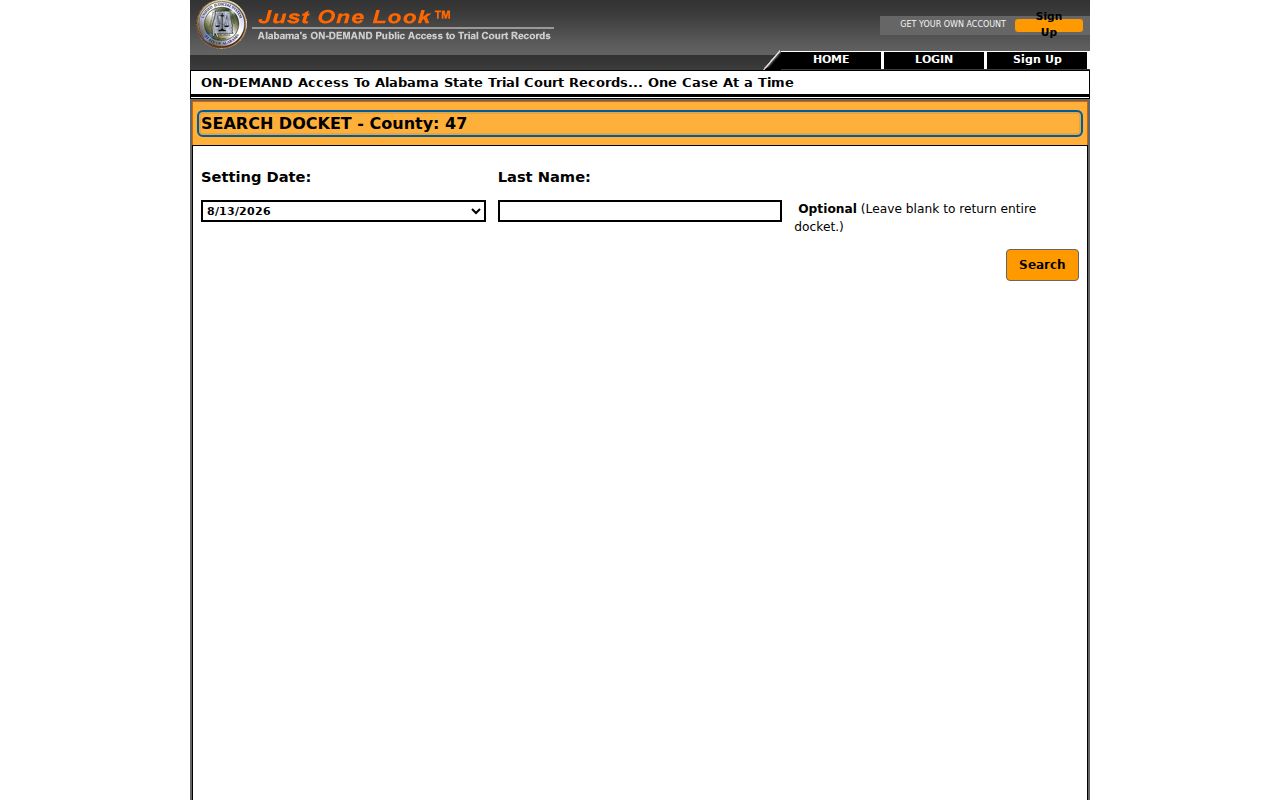
Notice how little the form asks for. With a known date, you can skip the surname entirely. It also pays to assume no filters the form never promised.
Finding Your Court Date
When a Madison County setting truly matters, use every channel you can. One source can be stale, thin, or aimed at a different court, and the latest filed notice is still the one that counts.
- Read the citation, summons, bond paper, or hearing notice. Identify the named court and the date printed by that court.
- For Circuit or District Court, run the free date query. Select the date and add the last name if it helps narrow the docket.
- For one known state case, check the latest AlacourtACCESS Case Action Summary and its Court Setting Dates block.
- On appearance day, use the county-endorsed Find My Courtroom service to check the room assignment.
- If sources conflict, call the correct Circuit Clerk division or visit its counter. An attorney in the case or the assigned judge's official office may also confirm an operative setting.
The clerk's divisions answer directly: Criminal at 256-532-3386, Civil at 256-532-3622, Family at 256-532-3424, and District Traffic at 256-532-3373. Free electronic Circuit and District docket viewing is open at the clerk's office during business hours under Alabama Rule 401. The county publishes no daily printed calendar, so plan on a call or a visit instead.
Madison County Courtroom Assignments
Find My Courtroom answers a narrower question than Search Docket. It points you to the room for an appearance. It cannot replace the court's notice or prove a hearing is still set. The uscourts.com address looks federal, but Madison County itself endorses the service. The county's regular Circuit and District cases are state matters. They are heard at the Madison County Courthouse, not federal filings.
A case record that names the judge opens another route. The official Circuit judge directory and District judge directory list rooms and office phones. Once you know the assigned judge, those offices serve as a final confirmation channel. The directories do not name calendar coordinators. So ask each office directly what it can confirm. The Circuit directory also gives a visual check. It shows the calendar offices tied to Circuit settings.
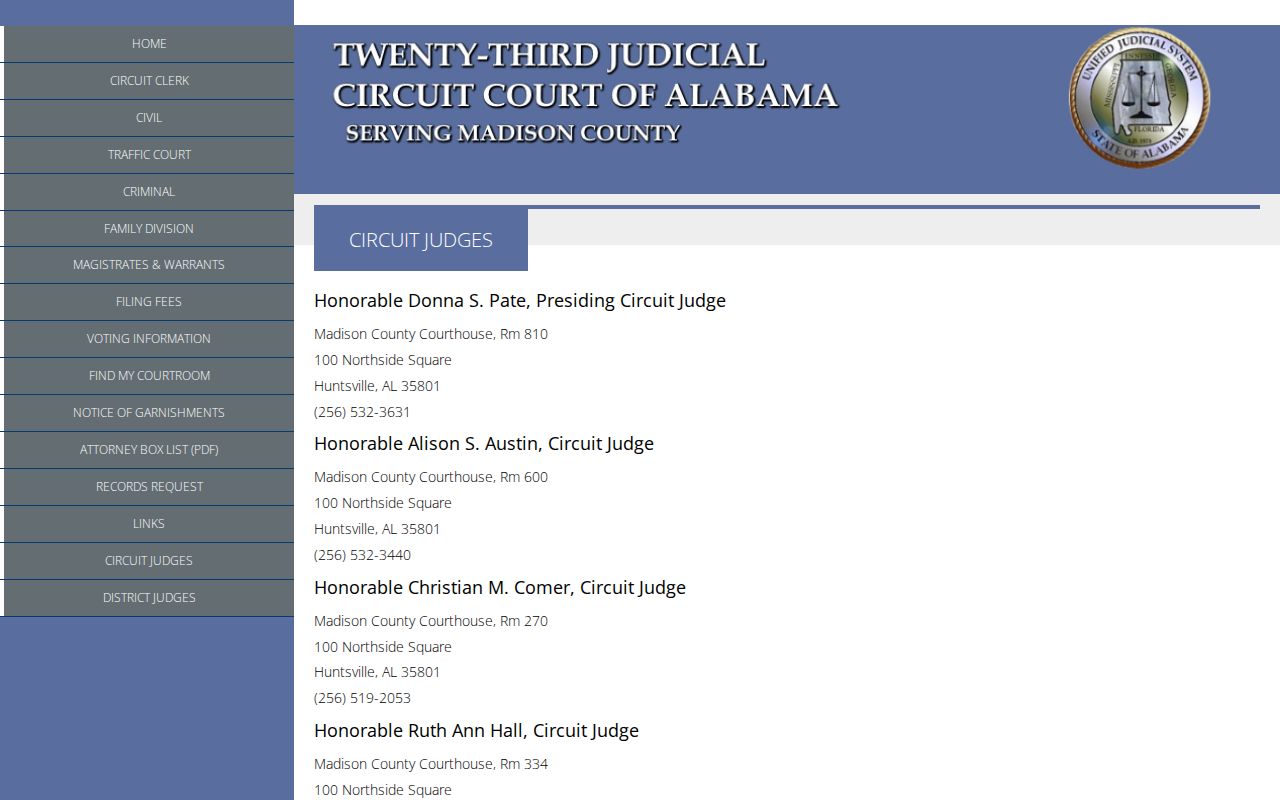
Room and office details tie the judge named on a docket to the right local office for confirmation.
How to Read a Court Setting
A setting is a scheduled appearance, not necessarily the trial. Read the whole line, then compare it against the newest notice or the latest Case Action Summary entry. A Madison County docket can carry several past and future settings, especially after continuances.
| Date | The day scheduled by the court. Check that it is the newest recorded setting. |
|---|---|
| Time | The appearance or docket-call time. District traffic has a recurring Tuesday morning docket. |
| Courtroom | The room assigned for the appearance. Use Find My Courtroom or the responsible office to verify. |
| Judge | The assigned judicial officer when the record identifies one. |
| Setting type | The purpose, such as arraignment, motion hearing, preliminary hearing, trial, or sentencing. |
Labels tell you what a setting means. A citation date is usually an initial appearance, not a trial. A preliminary hearing is an early District stage in a felony case. A motion hearing takes up a filed request. The word "trial" signals the merits or evidence stage. Those distinctions explain why one case can show two entries with different purposes.
Madison County Traffic Court Dates
District traffic is the easiest Madison County setting to pin down. The Madison District Traffic Court sets every county District traffic ticket on Tuesdays. The hearings start at 9 a.m. in Room 200. The date printed on your ticket is the initial appearance, not automatically a trial date. To contest a payable citation, follow the court's published process and request trial. Do not treat the first date as the hearing on the merits.
City citations run on their own calendars. Triana meets the second Thursday of each month in the evening. New Hope posts a monthly Thursday list you must check for the current year. Owens Cross Roads keeps review and trial dockets apart. Madison runs Thursday and Friday sessions, and Huntsville operates its own municipal court. The court name and issuing agency on the ticket decide which schedule controls.
Issuer check: A state-law county ticket usually routes to District Court. A municipal ticket stays with the issuing city's court unless appealed.
Continuances, Resets, and Cancellations
A continuance or reset shifts a setting to a new day. Ask yourself one thing first. Filing the motion changes nothing by itself. Madison County posts no public self-service continuance form. No local rule puts the old date on hold while a request sits pending. Until the judge or the court actually enters the change, the original notice still stands, so treat it as live. Trust only the newest setting entry. Or trust a fresh written notice, or straight confirmation from the office that set the hearing.
A closure notice creates the same trap. It explains why a court or office did not sit that day. But it never hands you a replacement date. Only the court can do that. Put the notice, the date docket, and the Case Action Summary side by side. If they disagree, call the clerk. One more wrinkle: AlacourtACCESS purchase history shows an older snapshot. Reopening a report you already bought is not the same as refreshing it.
Note: Keep the prior notice. The replacement Madison County court date must show up in an official entry or a new court notice first.
Madison County Judge Office Fallback
Say the Madison County docket gives you a judge. But the room or date stays fuzzy. The judge's own office is your backup once the clerk has not settled it. Nine Circuit judges and four District judges sit in the county's courthouse directory. Call the office of the assigned judge, not some random courtroom. Staff might send you back to the clerk or your lawyer. Even so, the directory spares you a blind guess. It shows which division or room handles the setting. This route works best when the case detail or a filed notice already names the judge. The District judge listing posts the official contacts for District settings.
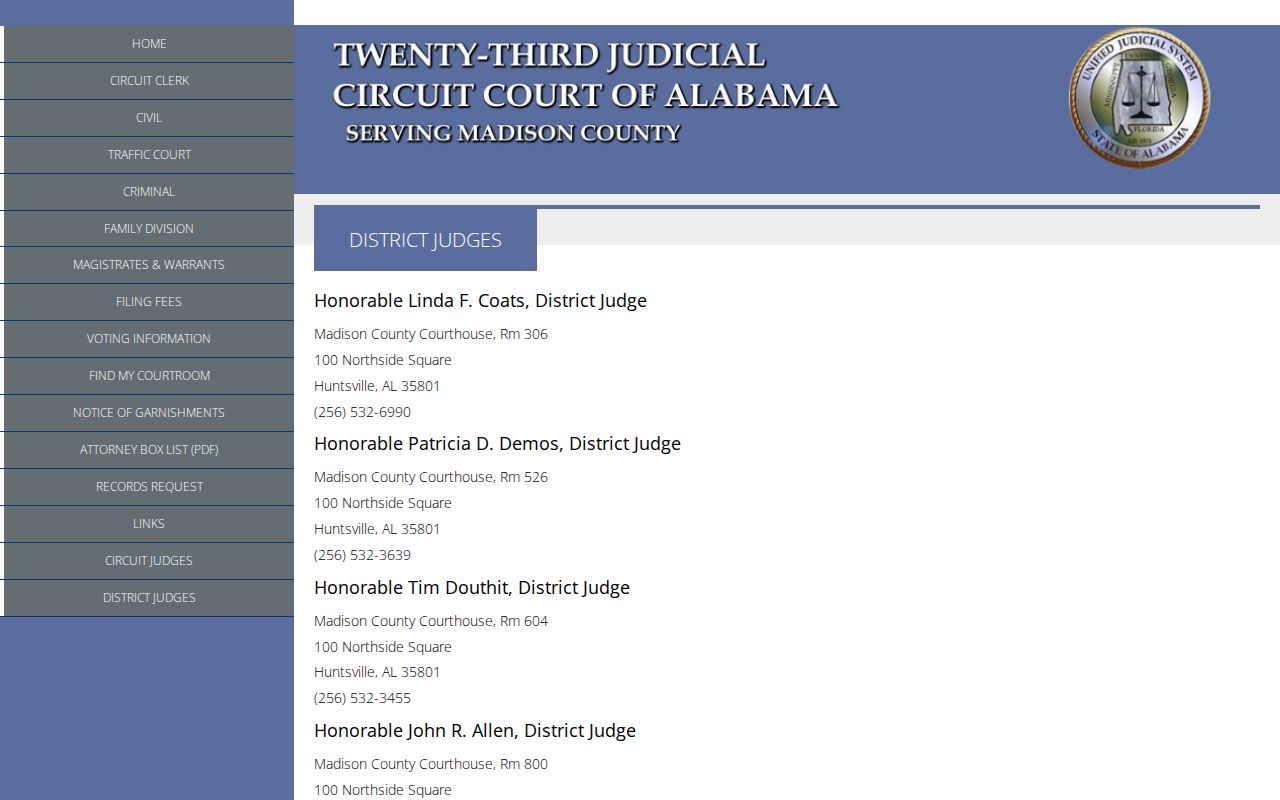
That is when a call makes sense. Go to the office only after the judge's name is clear from the case record or a filed notice.
If You Miss a Court Setting
Miss a Madison County court date? Act now. Call the court or clerk division listed on the notice, scan the newest docket activity, and reach your lawyer if you have one. Nothing resets on its own, so do not sit back and wait. What happens next depends on the case type and the court. In traffic or criminal matters, one missed setting can bring failure-to-appear activity, a warrant, license consequences, added charges, or bond forfeiture.
Missed a setting? Contact the responsible Madison County clerk or court promptly and ask what the current docket shows.
Do not appear at a guessed time or rely on an old portal snapshot when the court can confirm the next required step.
Legal counsel can address case-specific consequences and any request for relief.
Civil cases run differently. Skip a civil hearing and the court may enter an order or judgment on the record already before it. The free date docket might list a later setting. That does not undo what already happened. Pull the actual order if the outcome matters to you, and a full Madison County Case Lookup helps find the recorded action before you ask the clerk for a copy.
Madison County Calendar Terms
A Madison County court docket uses special terms for each stage of a case. Knowing what the words mean keeps a routine setting from looking like a final result.
- Setting date
- The scheduled date for a court appearance.
- Arraignment
- A criminal appearance for the formal charge and plea.
- Preliminary hearing
- A District Court probable-cause stage in a felony matter.
- Motion hearing
- A setting for argument or action on a filed request.
- Continuance or reset
- A court-approved move from one setting to another.
- Disposition
- The result or status that resolves a matter or stage.
The flow can be brief or long: notice › setting › hearing › order › later setting or disposition. Always follow the actual entries in the Madison County case instead of treating that sequence as guaranteed.